Translate

Translate

Thursday, 22 May 2014

Hell can be beautiful

We are about to interrupt the chronology of the blog (we mean we have still a couple of stories from Indonesia, that we will do our best to post shortly) as we've just had a couple of unusual experiences that we'd like to share as they're still 'hot'. In short, we have seen one of the most spectacular sites of our trip, we took an 'air-taxi' to get there; on the way back we had our first ever emergency landing; then we moved to the island where a prototype of bungee jumping has been practiced since at least 200 years and as regards the clothing of the local people - thatch skirt and (only) a leaf wrapped around the penis are still in fashion for women and men respectively.

We are in the country called Vanuatu - the archipelago located in the Pacific Ocean with New Caledonia to the South, Fiji to the East and Salomon Islands to the North West. If these names do not tell you very much, just bear in mind that the country is more than three hours flight away from Sydney, the opposite direction from Europe :). Vanuatu is located on the Pacific Ring of Fire so it should not come as a great surprise that the most amazing place to admire on the archipelago is ... an active volcano. The volcano, Mount Yasur, is situated on the Island of Tanna. Tanna's airstrip can only accept very small airplanes, so to get there we hopped on an air-taxi - a nine-seater, twin propeller engine driven aeroplane (actually it is an eight-seater, but the co-pilot place was taken by our fellow tourist, so the machine got upgraded to a nine-seater) . 
The outbound one hour flight was surprisingly stress-free, apart from the fact that the sole pilot looked desperately young (in case you were ever wondering why you see so few young pilots in Europe and where the best place for them to gain experience is...).

Once in Tanna, we got on a pick-up truck, and off we went to see boiling and splashing lava. We drove past extraordinarily lush Oceanian greenery that looked very different from the plants we were accustomed to. When we talked about Flores, have we mentioned the Wallace line? Yes or not, a short reminder - the Australian flora is very different from the Eurasian one and the dividing line (called Wallace line after an English naturalist) cuts the Indonesian archipelago into two; Flores and all the area that is to the West of it lies on the Australian side of the line. Hence, it's a constant pleasure to look at the greenery in these parts as it's always full of surprises. 
This photo was not taken on the way to Mt Yasur, though it shows well that the South Pacific flora is unusual :)  
At some point while we were driving (or rather 'bumping' up) up, rather suddenly, this abundant vegetation gave way to a totally barren, black and grey land, laden with volcanic ash. This undoubtedly meant one thing - we were getting close to one of the world's most active volcanos. And this landscape was the best witness that this one indeed kept on erupting every now and then. A short drive afterwards the cone of the mighty Mt Yasur emerged and it was biggie, biggie.
Can you see a white car at the cone of the volcano to the bottom right?
The tip of the cone was covered with an equally biggie plume of steam mixed with volcanic ash. We hopped off the truck and walked up a narrow footpath. As we approached the edge of the crater, the unmistakable smell of sulphur reached our nostrils. After a short hike we reached the rim of the cone (they say that this is the world's most easily accessible active volcano) and then we had our first look straight into the volcano's mouth, it was ... stunning, out-of-this-world, captivating... 
Every now and then (more or less every five to ten minutes) there was a frightening rumble, almost as loud as a thunderbolt during the storm, and lava splashed out form one of the two burning vents (i.e. holes in the ground).
The whole 'spectacle' was remarkably beautiful and at the same time spine-chilling. 
It brought to mind the eerie sight of Mordor from J.R.R. Tolkien's 'Lord of the Rings'. 
The time went by and we just stood there, watching down into the crater, as if it casted a spell on us, infatuated us; the sight was so captivating that it was hard to move on. We looked into hell and could not believe that hell can be so beautiful! 
The next day we experienced hell once again. However, this time it was not so beautiful any longer. On the return flight our small air-taxi got trapped amongst very thick clouds. Our brave young pilot was desperately looping and zig-zaging, trying to find a hole in that grey mass of steam ambushing us from every corner. He made so many circles that without the GPS, most likely, we would lose track of where we were going and would get lost somewhere in the Pacific infinity. The fuel gauges looked less and less reassuring and the visibility in Port Villa airport continued to be close to zero. Fuel running low - another brave decision by the pilot: ''hold on tight, re-read the safety notice, we are going to land on an old air-strip'', on the other (sunny) side of the island. So we made another U-turn; shortly after a long, rather rectangular stretch of grassland appeared through the windshield of the cockpit; the plane went lower and lower, a usual couple of shakes meant we were approaching the ground, engines roared even louder (making the whole experience even more spooky) and the plane touched down, and given the circumstances it did that rather smoothly:). Bravo to our pilot – as far as we are concerned, he passed the test to steer larger machines ;). 
As our small aircraft moved along the airstrip overgrown with grass it got very bumpy (not surprisingly as it was just a field), we were being jolted up and down until it came to a stop (at least once the safety belts served their purpose of keeping us in the seat). While driving down the airstrip, we contributed unintentionally to the 'welfare' of the local community by mowing one-and-a-half meter grass with the two propellers of our plane. 
The locals they never miss an opportunity to check out what's going on (when something is going on) and within five minutes half of the village came to say us hello.
So everything ended up well, within an hour a minibus came to pick us up and we got a free 'tour' of Efate Island on the way to our destination. The weather patterns on small volcanic islands makes us wonder - how come one village can enjoy a beautiful sunshine, whereas another village 20 kilometers away (still on the other side of the island and on the other side of the mountain) is bound to endure a torrential rain lasting for hours at the same time? We also found out some interesting facts about emergency landings (since while waiting for the minibus the pilot was eager to get involved in a 'question-and-answer session' on the perils of aviation) – theoretically even if the fuel goes completely down and we need to land on water, we still have 85% chance of survival, though in a small aircraft it is crucial to open the doors just before landing (or rather before touching the sea) as otherwise the pressure of the water would be too high to push them away...

The liana jumping and the traditional clothing are still to come, watch this space...


Monday, 19 May 2014

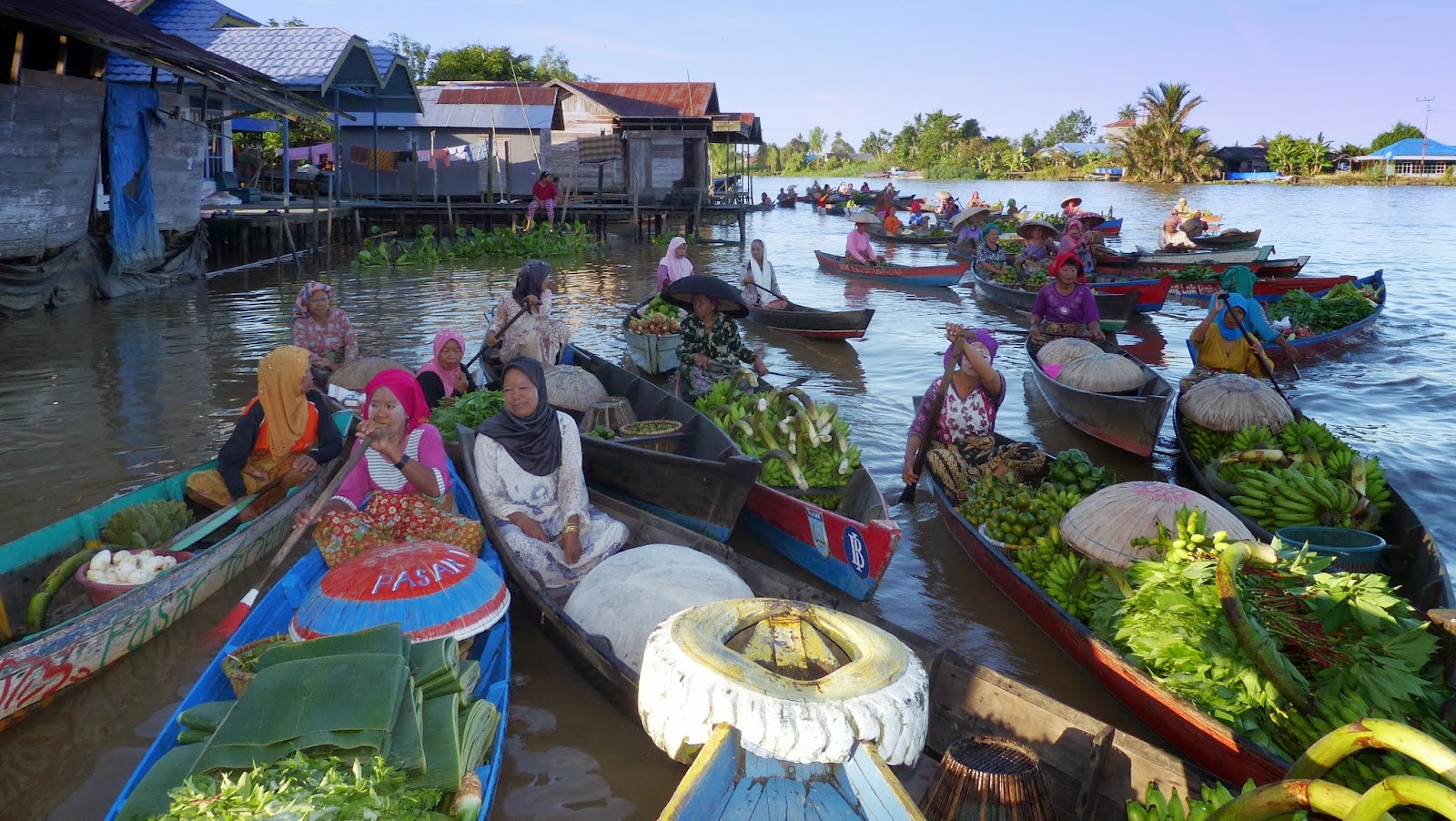
Visual Extravaganza at Banjarmasin Floating Market

Near the city of Banjarmasin, in South Kalimantan, Indonesian Borneo, since long, long time ago, no one can really tell since when exactly, the floating market takes place - Pasar Terapung Lok Baintan. On this market you can buy any locally grown product, straight from the boat. We won't talk much this time, just enjoy the views :)...
 It's amazing how neatly the things are arranged on the boats. 
Banana seems to be the king of the market...

Many boats are painted red and white; not a coincidence as the Indonesian flag is red on top and white at the bottom, actually it is just the opposite of the Polish one where white is on top, though it looks like the 'boatladies' prefer it the Polish way :)
 It might seem that there are much more sellers than buyers; not really, the goods are actually bartered, so everyone is a seller and a buyer at the same time ...
Pasar sounds a bit similar to Bazaar, doesn't it? And indeed the origins of the word for a market in Bahasa Indonesia can be traced back to a Persian bazar. Look more closely at the inscription on the boat in the left top corner!
It seems that the only person paying with money was Ievunia, the only Western tourist on the market :)
In the ruthless equatorial sun, a good 'sombrero' is indispensable
On the way to a day nursery :)?
There is also a catering boat...
...so that you never get thirsty or hungry


Friday, 9 May 2014

Trans-Flores Highway to ... Heaven

Flores is one of 17508 islands that form the Indonesian Archipelago. The name - Flores was given by the Portuguese explorers who 'discovered' the island in the 16th century. Flores means flowers in Portuguese and the legend has it that the early Portuguese gave the island this name because they were much impressed with the natural beauty of this place. This legend seems trustworthy to us, as the island's flora continues to impress up to this day. Although Flores is part of Indonesia, it is unique in many respects. Unique in the positive meaning of this word. Whereas the best known islands of the country - Java and Bali are incredibly densely populated, Flores is the land of little towns, indigenous villages and vast green areas. Whereas most of Indonesia is dirty and polluted, Flores seems tidy and clean. Whereas in other parts of Indonesia we suffered from almost suffocating heat, in Flores we often stayed at altitude, enjoying pleasant coolness of the air. There are also cultural differences - most of the Indonesians are Muslims (actually the country hosts the most populous muslim community in the world), Flores is Catholic and in some less accessible parts still animist.

Flores is already well established on the touristic itineraries, mainly because it is the starting point of excursions to Komodo island where one can admire the biggest lizard on Earth – Komodo dragon. The other great highlight of Flores are the coloured crater lakes of Kelimutu volcano. During our week on the 'Flowery' island we discovered, however, that is has much more to offer – indigenous villages in the mountains, rice terraces in the interior and great snorkeling off the coast.  

The town of Bajawa is beautifully set among lush greenery and almost perfectly conical volcanoes at an altitude of over 1000 meters. This mountainous setting offers not only great views but also a much desirable escape from an oppressive heat of the equatorial latitudes. Bajawa is a good starting point to explore the indigenous villages of the native Ngada people.  
What Flores has in common with the rest of Indonesia is its ethnic diversity. Only around Bajawa at least six separate languages are identifiable. We visited the villages of Ngadha people. Their settlements have characteristic houses with a very tall, thatched roofs, for the shape of the roofs they are sometimes dubbed 'beehive' houses. The umbrella shaped structures that you can see in the square in the middle of the village are actually not the picnic tables, but ngadhu - carved poles, each one of them stands for a person or a group of people that came from another village (usually after they got married to the local). Interestingly, in Ngadha culture it is the man who moves to the village of his wife (in most cultures it is the woman who moves) and one of his sisters customarily moves in together with him. What stroke us most in the first village – Bena, was how extraordinarily tidy and well preserved it was. 
From Bena we set off for a few hours hike to nearby villages ...
... the hike was also rewarding in terms of spectacular vistas.
We could calmly explore the place as we were the only foreigners in the villiage.
It is easy to tell where the male and female elders live - over the man's house is a humanlike figurine, whereas over the female one there is a house:)
Buffalos are much valued and slaughtered only for very important ceremonies. Their skulls with big horns 'beautify' the houses and their number and size demonstrate the affluence of each household.  
We were brought to the villages by the local guide always proudly holding on to his machete. By the way, in this photo you can see our good friend Raf, who courageously joined us for almost four weeks, to our great joy :).

Raf even made friends with local 'girls' :).  
Visitors come, visitors go; the village life goes on, the kids are having fun using their imagination to come up with new toys... rubber bike tyres seem to be all time favourites in whatever culture and place of the world we visited...
... as well as plastic bags floating in the wind...
... whereas in our latitudes we used to play with beer-bottle tops, the Flores kids prefer fresh coffee beans...
... in abundance on the island.

The interior of Flores is covered either with rainforest or with spectacular rice terraces.
These vistas made us reminisce about the Banaue rice terraces in the Philippines. The Filipino terraces set dramatically in the steep mountains were clearly higher, simply mind-blowing at the first sight. 
Their Flores counterparts maybe are not so overwhelming on first seeing, but are still extraordinary...
And when it comes to beauty of the rice terraces, Flores has its trump card – the unique 'spider web' terraces.

On the way we also paid a visit to Arak distillery, the local strong (and rather disgusting) spirit made out of palm juice.  

Kelimutu volcano is the most famous attraction of Flores. It's a volcano with three differently coloured lakes in its three calderas. The waters of the lakes are fed by volcanic gases, they get very acid, which explains the different colours. The ascent to the top of the volcano usually starts in the early morning from the nearby village of Moni to catch to colourful caldera views together with the spectacle of the rising sun in the background.


We could not tell the colour of the third lake as it prudishly covered itself with the mist.  
Can you see a small rainbow in the middle a bit to the left in the photo above?

And then came the coastal town of Labuan Bajo. When we saw the view of the harbour from our hotel room terrace we had one of this 'wow' moments. 

Interestingly, in Labuan Bajo there are two Italian restaurants. Interestingly, because in the rest of Flores the food was super basic. Yes, this was a price to pay for enjoying all those vistas – a culinary ramadan. And then in LB out of the blue two Italian restaurants, run by real Italians who, like in real Italy, come over to your table to ask if everything is fine – in short real gourmet extravaganza, happy times. We got so carried away with ordering food, wine and desserts (especially Mariushki who after devouring the main dish of tuna steak still needed a pizza on top, to satisfy his hunger) that our bill for one single evening was higher than all bills together for the rest of our Flores trip. The sudden presence of Italians in this charming town made us wonder why on Earth they appear like deus ex machina in all places that are beautiful – they sunbathe on the picturesque shores of the Indian Ocean in Zanzibar and Kenya, they kite- and wind-surf in scenic Jericoacoara in Brazil and Los Coches archipelago in Venezuela, they party in the charming Greek island of Paros. The point is that you don't meet many Italians on the way most of the time, but you meet relatively many of them in places of exceptional beauty – yes, those guys have good taste indeed.

In Labuan Bajo we organised the boat for a three-day cruise to Komodo Island. More precisely, our driver-guide Charles organised it for us. By the way, we wholeheartedly recommend Charles if one day you want to go on a similar cross-Flores trip: + 62 812 389 501 20.  

So we 'set sail' in search of the biggest monitor lizard in the world. To be totally honest it was not a sail boat, but a wooden motor boat; long enough to hold two (mini-) cabins each with a bunker bed and a large dining table in front. On the upper deck, there was a space to lie down, not very useful during the day (unless someone wants to get a lobster coloured body), but much appreciated at night to gaze at the sky full of stars. It was not a luxury boat either. Actually, the conditions were outright rudimentary, but it did not really matter. The boat was good enough to rock us slowly forward across the super calm sea. As long as fresh, warm breeze blew, turquoise water splashed around, the small lushly green islands went past, this sea trip was an attraction in itself. We spent most of the time lazying around on the deck, reading books or just admiring the natural beauty around. And, most importantly, to become our well-being complete, we had an excellent cook :).

We had two landings, the first of them on Rinca Island. We liked small crabs with one pincer much longer than the other; the ranger explained us that it uses the long claw for fighting, whereas the short one for feeding.

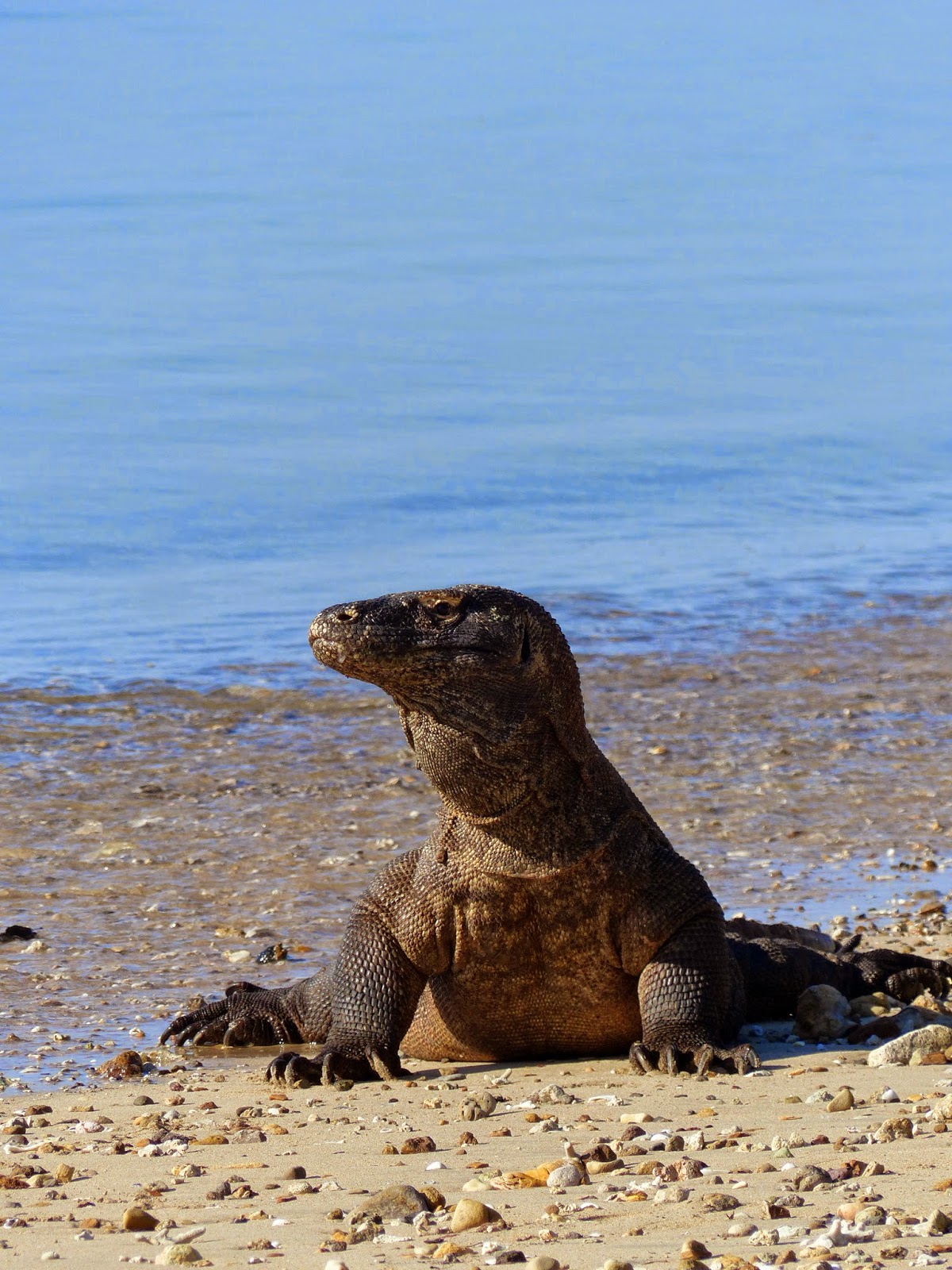
The second landing came about at Komodo Island itself. The hour-and- a-half trekking gave us ample opportunities to admire its most famous inhabitant – Varanus komodoensis. And yes, Komodo Dragon is really big, and yes it looks scary, even repugnant to some.  
 At the first sight it looks like a crocodile, though genetically it is a lizard. 
They have powerful claws ...
While it walks, it keeps on sticking its forked tongue in and out to ... sniff food. The obvious questions comes to mind – how can any animal smell with a tongue? Alike other lizards it has an auxiliary smelling organ in the mouth (called Jacobson's organ), which enables it to smell from the particles that stick to the tongue; that's why the tongue needs to move constantly in and out.

As Komodos are lazy by nature, they generally feed on carrion – decaying flesh of other animals. However, they can be very dangerous to humans, other animals and even to other Komodos. 
... and even one bite can end up fatally as their saliva contains venom. 
They are also excellent swimmers so if you happen to be chased by one, running into the sea is not an option.  

Fortunately, most of the time they are extremely lazy and while they slack around, you can get quite close to them.  

The boat operator provided us with a snorkel, mask and flippers of a pretty decent quality (our snorkeling attempts in Zanzibar made us realise that this is not always the case). Therefore, much to our delight, apart from Komodo dragons tracking, another activity that made us move out from the boat was snorkeling. The snorkeling across the coral reefs of Komodo archipelago, a bit unexpectedly, came to be one of the highlights of our trip. The coral reefs are extensive and full of vivid colours; among the reefs masses of brightly coloured fish pass by. The water has amazing transparency and the two mixing undersea currents – cold and warm bring a spectacular abundance of sea life. We felt as if we were swimming in a beautiful aquarium or in the National Geographic's submarine show. On top of that, to make our jaw-dropping complete manta rays turned up. These huge creatures, in spite of their size and fearsome black colour, in reality are very gentle and friendly to humans (they are not to be confused with dangerous stingrays). They swim near the surface of the sea, so they are perfectly visible from the boat. 


When mantas appeared our boat crewmen (or rather crewboys) cheered us up enthusiastically: 'Manta, Manta! Mister, Miss, jump in, jump in, now, now'! As mantas are more than a meter long (and at that time we were not sure whether they were dangerous or not), the prospect of jumping in between them seemed at first a hair-raising idea. Somehow we plucked up the courage, off we dived and all we can say is that the experience to swim next to them is priceless. The only shame we felt (afterwards of course, as while we were in the water we just enjoyed the moment) was that we did not have a waterproof camera.  

By the way, have you ever seen a twin banana :)?